Institucions culturals

La recerca científica és una part important de l’activitat del Museu des dels seus orígens, amb l’objectiu d’estudiar i interpretar la diversitat de la vida i de les estructures geològiques que li donen suport, amb especial atenció als medis mediterranis.En aquesta tasca, el Museu se centra tant en la recerca basada en les col·leccions com en l’estudi de les espècies en el seu medi natural i avalua les interaccions amb l’entorn i entre elles.
Si sou personal o col·laborador del Museu de Ciències Naturals de Barcelona, i heu publicat un article científic o document de recerca, si us plau contacteu amb bibmuseuciencies@bcn.cat per dipositar-lo a RECERCAT.


Analyses of 45,000-year-old bones from Europe allow scientists to pin down when modern humans interbred with Neanderthals, shedding light on the histories of populations with no present-day descendants.
With more than 10,000 ancient human genomes published in 2023, thanks to new technological developments on DNA sequencing, we are now able to investigate multiple ancestry layers associated to past migrations that have ...
Guaitacargols és un projecte adreçat a centres d’educació secundària que proposa fer un estudi de la biodiversitat de cargols terrestres en espais propers als centres. La iniciativa és impulsada pel Museu de Ciències ...
The Xerces Blue (Glaucopsyche xerces) is considered to be the first butterfly to become extinct in historical times. It was notable for its chalky lavender wings with conspicuous white spots on the ventral wings. The last ...
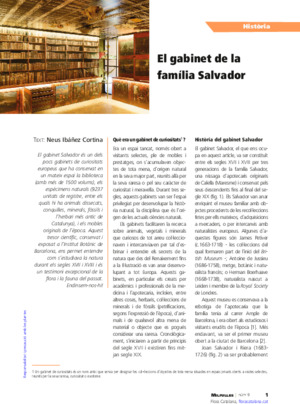
El gabinet Salvador és un dels pocs gabinets de curiositats europeus que ha conservat en un mateix espai la biblioteca (amb més de 1500 volums), els espècimens naturals (9237 unitats de registre, entre els quals hi ha ...
Exploring natural materials offers countless opportunities for inclusive science. At the Museu de Ciències Naturals de Barcelona (Natural Science Museum of Barcelona), we know that looking closely at real materials creates ...
The Catalan Initiative for the Earth BioGenome Project (CBP) is an EBP-affiliated project network aimed at sequencing the genome of the > 40000 eukaryotic species estimated to live in the Catalan-speaking territories ...
Western Eurasia witnessed several large-scale human migrations during the Holocene. Here, to investigate the cross-continental effects of these migrations, we shotgun-sequenced 317 genomes—mainly from the Mesolithic and ...

The rise and fall of the Roman Empire was a socio-political process with enormous ramifications for human history. The Middle Danube was a crucial frontier and a crossroads for population and cultural movement. Here, we ...
L’article presenta el pla d’acció per a la perspectiva de gènere del Museu de Ciències Naturals de Barcelona 2021-2023, fruit d’un procés llarg i sense referents que ha implicat una part important del personal del museu. Les ...

This study presents an exceptional collection of 54 Late Pleistocene human remains that correspond to at least three Neanderthal individuals from Simanya Gran, the main gallery of Cova Simanya, located in the northeastern ...
El Niu Volant viatja del Museu de Ciències Naturals a les escoles bressol per apropar-hi propostes didàctiques d’aprenentatge de les ciències naturals. Després de l’experiència amb el Niu Volant, dues escoles han transferit ...
Human populations underwent range contractions during the Last Glacial Maximum (LGM) which had lasting and dramatic effects on their genetic variation. The genetic ancestry of individuals associated with the post-LGM Magdalenian ...
Increasing numbers of ancient genomes from the Viking period retrieved across the North Sea regions are revealing a complex layer of genetic ancestries and a past cosmopolitanism that was triggered by different mobility patterns.
The first studies to retrieve genome-wide data from two Medieval European Jewish communities from England and Germany illustrate the complex interplay of ancestry, disease, religion, culture and ethics.
Museo-what? Museomics! Museomics is emerging as a distinct discipline from ancient DNA research and involves natural history museums and herbaria across the world. Museomics can be defined as the application of -omics ...

Human populations have been shaped by catastrophes that may have left long-lasting signatures in their genomes. One notable example is the second plague pandemic that entered Europe in ca. 1,347 CE and repeatedly returned ...

El Museu de Ciències Naturals de Barcelona (MCNB) té com a objectiu generar i compartir coneixement amb la voluntat de crear una societat més informada, connectada i responsable amb la natura. Aquest objectiu s’assoleix ...