Articles publicats en revistes: Recent submissions
Now showing items 21-40 of 90

Continent-wide drivers of spatial synchrony in breeding demographic structure across wild great tit populations
Variation in age structure influences population dynamics, yet we have limited understanding of the spatial scale at which its fluctuations are synchronised between populations. Using 32 great tit populations, spanning ...
Idiosyncrasy of feather mite intensity and prevalence across passerine bird species: a comparative study
Symbionts are key elements of ecosystems, by playing important roles in shaping the biology and ecology of their hosts. However, the factors determining symbiont loads across host species are still unclear. Nowadays, we ...
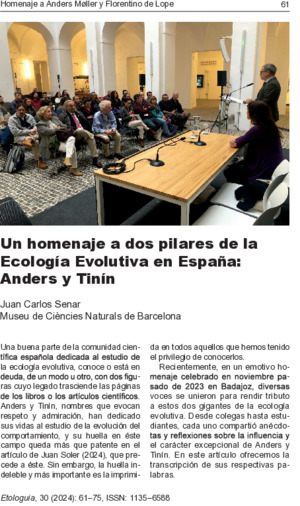
Un homenaje a dos pilares de la ecología evolutiva en España: Anders y Tinín
Homenaje a Anders Møller y Florentino de Lope
Testing for parallel genomic and epigenomic footprints of adaptation to urban life in a passerine bird
Identifying the molecular mechanisms involved in rapid adaptation to novel environments and determining their predictability are central questions in Evolutionary Biology and pressing issues due to rapid global changes. ...
Age and sex differences in niche use at molt and its effect on plumage coloration characteristics in a bird
Bird plumage is often very colorful and can communicate the quality of the bearer to conspecifics. These plumage-based signals of quality are composed of multiple pigments (e.g., melanin and carotenoids). Therefore, sex ...

Ectoparasite sharing among native and invasive birds in a metropolitan area
Parasite-mediated competition has been reported to be one of the most harmful, although overlooked, impacts that alien species have on native ecosystems. Monk parakeets Myiopsitta monachus are successful invaders in Europe, ...
Personality and urbanization: behavioural traits and DRD4 SNP830 polymorphisms in great tits in Barcelona city
Most examples of adaptation to the urban environment relate to plasticity processes rather than to natural selection. Personality, however, defined as consistent individual differences in behaviour related to ...
The diet of great tit nestlings: comparing observation records and stable isotope analyses
The diet of wild animals has been studied using many different strategies, approaches and methods in recent decades. In this regard, stable isotopes analysis (SIA) is becoming a widespread tool, but no study has yet, to ...
Reducing the availability of food to control feral pigeons: changes in population size and composition
BACKGROUND: As feeding by humans is one of the main food resources to pigeons (Columba livia), there is general agreement that public education that aims to reduce the food base may be the most feasible way to reduce ...
Integrating genomics and biogeography to unravel the origin of a mountain biota: the case of a reptile endemicity hotspot in Arabia
Advances in genomics have greatly enhanced our understanding of mountain biodiversity, providing new insights into the complex and dynamic mechanisms that drive the formation of mountain biotas. These span from ...
Mediterranean versus Atlantic monk parakeets Myiopsitta monachus: towards differentiated management at the European scale
BACKGROUND: The monk parakeet Myiopsitta monachus (Boddaert), native to South America, is an invasive species in several European countries, causing crop damage and potential negative impacts on wildlife. Only Spain and ...
The reproductive capacity of Monk Parakeets Myiopsitta monachus is higher in their invasive range
Breeding parameters for Monk Parakeets Myiopsitta monachus nesting in Barcelona, Spain, were collected for 651 nests over five breeding seasons. This invasive population has a high reproductive capacity compared with the ...
Did you learn what to eat from your parents? A test of the early learning of the foraging niche hypothesis in great tits Parus major
A growing number of studies suggest that individuals can develop long-term foraging specializations independently of phenotypic or environmental variation, yet little is known about how the foraging niche is acquired. The ...
Social associations are predicted by nest proximity but not kinship in a free-living social parrot
Social associations among conspecifcs are typically non-random, ofen being a function of relatedness, familiarity, or spatial distributions. Te aim of this study was to combine feld observations with molecular genetic ...
Clinging on the brink: whole genomes reveal human-induced population declines and severe inbreeding in the critically endangered emirati Leaf-toed Gecko (Asaccus caudivolvulus)
Human-mediated habitat destruction has had a profound impact on increased species extinction rates and population declines worldwide. The coastal development in the United Arab Emirates (UAE) over the last two decades, ...
Integrative systematic revision of the Montseny brook newt (Calotriton arnoldi), with the description of a new subspecies
The Montseny brook newt (Calotriton arnoldi), a glacial relict endemic to a small, isolated massif in northeast Spain, is considered the only Critically Endangered urodele in Europe. Its restricted range is divided by a ...
Rewinding the invasion history of monk parakeets in Barcelona city: 1976-2022
Predicting the future abundance and distribution of introduced alien species is crucial to mitigate their impact on ecosystems, but this has been shown to be highly challenging. A good approach to obtain crucial clues ...
Prevalence of sensitization to avian or fungal proteins in different work environments
Hypersensitivity pneumonitis (HP) is usually caused by the inhalation of avian and fungal proteins. The present study assesses a cohort of Urban Pest Surveillance and Control Service (UPSCS) workers with high exposure to ...
First record of dermal fluorescence in the desert-adapted Stenodactylus and Trigonodactylus geckos
Even though steadily increasing, biofluorescence is a rarely documented phenomenon in vertebrates. Within geckos, only six species have been shown to produce fluorescence and only one case of dermal fluorescence has been ...
Cooperation and conflict in the building and maintenance of the compound nests of monk parakeets Myiopsitta monachus
Colonial birds often breed at high density, generating conflict among neighbours over the use of nest-building materials. However, in a few colonial species, breeders appear to cooperate in the construction of compound ...
