Institucions culturals


Mostrando ítems 1-20 de 81
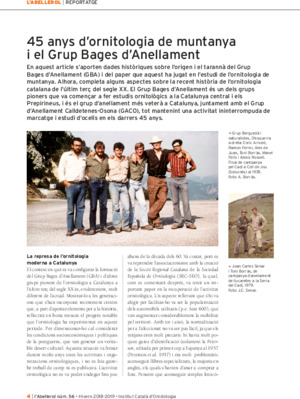
En aquest article s’aporten dades històriques sobre l’origen i el tarannà del Grup Bages d’Anellament (GBA) i del paper que aquest ha jugat en l’estudi de l’ornitologia de muntanya. Alhora, completa alguns aspectes sobre ...

The low breeding performance and body condition of nestling passerine birds in urban environments has been attributed to the poor quality and low abundance of food in these settings. However, detailed data on prey provided ...
Biological responses to climate change have been widely documented across taxa and regions, but it remains unclear whether species are maintaining a good match between phenotype and environment, i.e. whether observed trait ...
Bird plumage is often very colorful and can communicate the quality of the bearer to conspecifics. These plumage-based signals of quality are composed of multiple pigments (e.g., melanin and carotenoids). Therefore, sex ...
Many animals show behavioural syndromes (i.e. suites of correlated behaviours across multiple situations). These behavioural correlations, however, imply limitations in the behavioural plasticity of individuals when facing ...
According to current theory, the development of different conspicuous ornaments may provide multiple, redundant or unreliable information. However, multiple visual and acoustic traits have not often been tested at the same ...

ABSTRACTAimEffective policy and management responses to the multiple threats posedby invasive alien species (IAS) rely on the ability to assess their impacts beforeconclusive empirical evidence is available. A plethora of ...
Dozens of morphologically differentiated populations, subspecies and species of crossbills (genus Loxia) exist. It has been suggested that this divergence is due to variation in the conifer cones that each population ...
The phenology of many species shows strong sensitivity to climate change; however, with few large scale intra-specific studies it is unclear how such sensitivity varies over a species’ range. We document large intra-specific ...
Diet specialisation during brood rearing has important consequences on parental reproductive success and on the recruitment rate of offspring. However, very little is known about the long-term consistency of parents when ...

Venoms have traditionally been studied from a proteomic and/or transcriptomic perspective, often overlooking the true genetic com- plexity underlying venom production. The recent surge in genome-based venom resear c h ...
Human-mediated habitat destruction has had a profound impact on increased species extinction rates and population declines worldwide. The coastal development in the United Arab Emirates (UAE) over the last two decades, ...
1. The integration and synthesis of the data in different areas of science is drastically slowed and hindered by a lack of standards and networking programmes. Long‐term studies of individually marked animals are not an ...

Variation in age structure influences population dynamics, yet we have limited understanding of the spatial scale at which its fluctuations are synchronised between populations. Using 32 great tit populations, spanning ...
Urbanisation is increasing worldwide, and there is now ample evidence of phenotypic changes in wild organisms in response to this novel environment. Yet, the genetic changes and genomic architecture underlying these ...

Individual variation among and within natural populations can have eco-evolutionary implications by, for example, affecting species interactions or evolutionary potential. Urban systems present a unique opportunity to ...
Colonial birds often breed at high density, generating conflict among neighbours over the use of nest-building materials. However, in a few colonial species, breeders appear to cooperate in the construction of compound ...

In the arid landscapes of the Arabian Peninsula, high levels of cryptic diversity among reptiles, and especially in geckos, have recently been revealed. Mountain ranges within the peninsula were shown to contain the ...
A growing number of studies suggest that individuals can develop long-term foraging specializations independently of phenotypic or environmental variation, yet little is known about how the foraging niche is acquired. The ...
Food is a main limiting factor for most populations. As a consequence, knowledge about the diet of invasive alien species determines the design of control measures. The Monk and Rose-ringed parakeets are two typical species ...
