Departament d'Ecologia Evolutiva i de la Conducta: Recent submissions
Now showing items 41-60 of 102
Integrative systematic revision of the Montseny brook newt (Calotriton arnoldi), with the description of a new subspecies
The Montseny brook newt (Calotriton arnoldi), a glacial relict endemic to a small, isolated massif in northeast Spain, is considered the only Critically Endangered urodele in Europe. Its restricted range is divided by a ...
Rewinding the invasion history of monk parakeets in Barcelona city: 1976-2022
Predicting the future abundance and distribution of introduced alien species is crucial to mitigate their impact on ecosystems, but this has been shown to be highly challenging. A good approach to obtain crucial clues ...
Prevalence of sensitization to avian or fungal proteins in different work environments
Hypersensitivity pneumonitis (HP) is usually caused by the inhalation of avian and fungal proteins. The present study assesses a cohort of Urban Pest Surveillance and Control Service (UPSCS) workers with high exposure to ...
First record of dermal fluorescence in the desert-adapted Stenodactylus and Trigonodactylus geckos
Even though steadily increasing, biofluorescence is a rarely documented phenomenon in vertebrates. Within geckos, only six species have been shown to produce fluorescence and only one case of dermal fluorescence has been ...
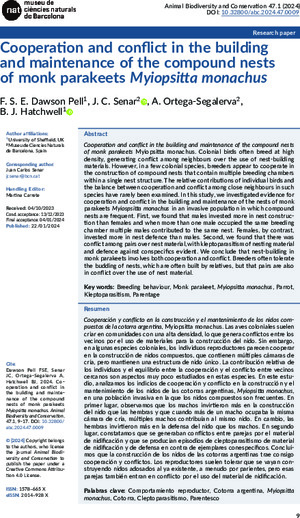
Cooperation and conflict in the building and maintenance of the compound nests of monk parakeets Myiopsitta monachus
Colonial birds often breed at high density, generating conflict among neighbours over the use of nest-building materials. However, in a few colonial species, breeders appear to cooperate in the construction of compound ...
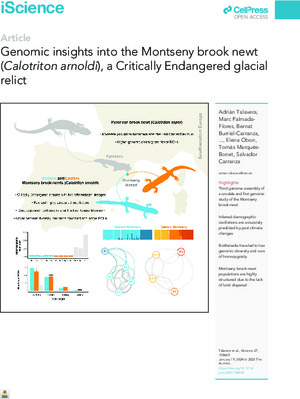
Genomic insights into the Montseny brook newt (Calotriton arnoldi), a critically endangered glacial relict
The Montseny brook newt (Calotriton arnoldi), considered the most endangered amphibian in Europe, is a relict salamandrid species endemic to a small massif located in northeastern Spain. Although conservation efforts should ...
Host space, not energy or symbiont size, constrains feather mite abundance across passerine bird species
1. Comprehending symbiont abundance among host species is a major ecological endeavour, and the metabolic theory of ecology has been proposed to understand what constrains symbiont populations. 2. We parameterized metabolic ...
Native and invasive bird interactions increase the spread of Newcastle disease in urban environments
Due to their large population sizes, synanthropic birds, including native and invasive species, can transmit pathogens to other vertebrates, and even humans. In particular, Newcastle disease virus (NDV) can cause lethal ...
Hidden in the sand: phylogenomics unravel an unexpected evolutionary history for the desert-adapted vipers of the genus Cerastes
The desert vipers of the genus Cerastes are a small clade of medically important venomous snakes within the family Viperidae. According to published morphological and molecular studies, the group is comprised by four species: ...
Niche shifts over spread of a biological invasion: unveiling the role of changing habitat preference and density-dependence
Aim Anticipating the ultimate fraction of a landscape that might be susceptible to invasion is challenging as several species are able to expand the range of environmental conditions used over invasion. Despite its ...
Sensitization to avian and fungal proteins in diferent work environments
Introduction Hypersensitivity pneumonitis (HP) is usually caused by the inhalation of avian and fungal proteins. The present study assesses a cohort of Urban Pest Surveillance and Control Service (UPSCS) workers with high ...
Evidence for vocal signatures and voice-prints in a wild parrot
In humans, identity is partly encoded in a voice-print that is carried across multiple vocalizations. Other species also signal vocal identity in calls, such as shown in the contact call of parrots. However, it remains ...
Dispersal behaviour and settlement in an invasive bird: dispersers prefer their natal habitat
Habitat selection has profound consequences for individual fitness, but how do animals decide where to settle? The natal habitat preference induction (NHPI) hypothesis proposes that individuals choose habitats that exhibit ...
Breeding great tit Parus Major individuals have moderately consistent foraging niches across years
Diet specialisation during brood rearing has important consequences on parental reproductive success and on the recruitment rate of offspring. However, very little is known about the long-term consistency of parents when ...
Longevity records of citril finches Carduelis citrinella: analysing 43 years of continuous ringing
Longevity records (maximum lifespan) of free-ranging birds are basic to understand the evolution of avian senescence patterns. Here we provide minimum longevity records for the citril finch Carduelis citrinella, an endemic ...

The effect of climate change on avian offspring production: a global meta-analysis
Climate change affects timing of reproduction in many bird species, but few studies have investigated its influence on annual reproductive output. Here, we assess changes in the annual production of young by female breeders ...
Heterospecific nest material kleptoparasitism: observations of grey herons, Ardea cinerea, removing material from the nests of monk parakeets, Myiopsitta monachus
Nest material kleptoparasitism occurs when an individual steals material from another individual's nest. Here we document 69 observations of grey herons, Ardea cinerea, removing nest material from the nests of monk parakeets, ...
Long-distance dispersal of monk parakeets
Las especies invasivas amenazan la biodiversidad en todo el mundo y, por ello, en el ámbito de la biología de la conservación se considera prioritario determinar las causas y mitigar los efectos de este fenómeno. Uno de ...

