Departament de Vertebrats: Envíos recientes
Mostrando ítems 61-79 de 79
Biodiversity in storerooms
Zoology collections preserved in museums worldwide contain a broad variety of materials. Designing and adapting storerooms for theses collections is no easy task and is more difficult when reusing existing buildings. ...
La transversalité dans les musées d'histoire naturelle: de la collecte des spécimens aux expositions
The activity of natural history museums is based on the principle of nature sharing. Although no single museum has exclusive rights over a particular fraction of nature, specialised museums and reference centres do exist. ...
Effects of prolonged freezing on the preparation quality of fresh material destined to bird collections
The preparation of animal specimens destined for zoological collection is a key step to ensure and maintain an optimal conservation state in the long term. Animal skins and bones are a common element in zoological collections ...
Revising birds' skin preparation for facilitating its scientic utility
Bird skins are traditionally prepared with folded wings, but reviewing some features of this material such as plumage details, and biometric measurement can be difficult when folded. To facilitate the research consultation ...
La interoperativitat de les eines de descripció de museus, arxius i biblioteques.
El patrimonio de los museos (colecciones, archivos, bibliotecas) y la actividad científica (proyectos de investigación, edición de revistas y monografías) constituyen una plataforma de fuentes documentales diversas y ...
The primate collection at the Natural Science Museum of Barcelona (Spain)
The Natural Science Museum of Barcelona (MCNB) houses a total of 309 specimens of non–human primates. The collection comprises 102 stuffed animals, 33 skins, 73 skeletons, 24 postcranial skeletons, eight mounted skeletons, ...

Genotipar sin capturar
En los últimos años, los avances en técnicas moleculares han sido aplicados en taxonomía, ecología, biología evolutiva y biología de la conservación. Es preferible que los estudios genéticos de la fauna salvaje se realcen ...
Coloración estructural del plumaje: influencia de la dieta y aplicaciones en conservación de aves
Proyecto de investigación de una estancia en el Centro de Investigación de Ecosistemas de la Universidad Nacional Autónoma de México de abril a octubre del 2006. Varios estudios sugieren que producir las coloraciones ...

Space invaders: house sparrow densities along three urbanagricultural landscapes
One of the most successful avian urban invaders is the House Sparrow (Passer domesticus). Here, we examine House Sparrow numbers in the urban-agricultural landscape of three cities, one where the sparrow is native (Barcelona) ...

Records of fatal attacks by Rose-ringed parakeets "Psittacula krameri" on native avifauna
Interspecific interactions between invasive and native fauna are poorly studied. Here we report six fatal attacks by Rose-ringed Parakeets Psittacula krameri, one of the most successful invasive avian species in Europe, ...
The diet of Great Tit Parus major nestlings in a Mediterranean Iberian forest: the important role of spiders
The diet of the Great Tit Parus major when rearing chicks has been described in many studies. However, data from the Mediterranean area is scarce. Here we describe the diet of nestlings in a population of Great Tits in a ...

Selection based on the size of the black tie of the great tit may be reversed in urban habitats
A standard approach to model how selection shapes phenotypic traits is the analysis of capture–recapture data relating trait variation to survival. Divergent selection, however, has never been analyzed by the capture–recapture ...
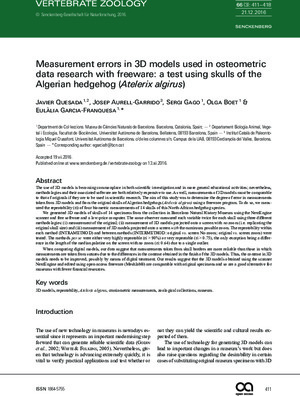
Measurement errors in 3D models used in osteometric data research with freeware: a test using skulls of the algerian hedgehog (Atelerix algirus)
The use of 3D models is becoming commonplace in both scientific investigation and in more general educational activities; nevertheless, methodologies and their associated software are both relatively expensive to use. As ...
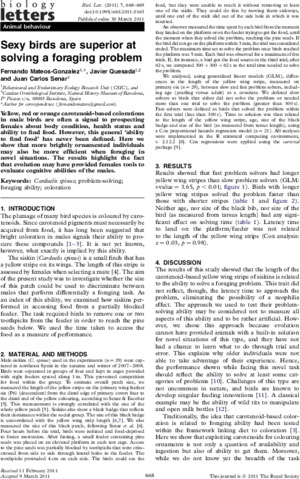
Sexy birds are superior at solving a foraging problem
Yellow, red or orange carotenoid-based colorations in male birds are often a signal to prospecting females about body condition, health status and ability to find food. However, this general ‘ability to find food’ has never ...

Is response to fire influenced by dietary specialization and mobility? A comparative study with multiple animal assemblages
Fire is a major agent involved in landscape transformation and an indirect cause of changes in species composition. Responses to fire may vary greatly depending on life histories and functional traits of species. We have ...
